April – October 2016
Portfolio
of Possibilities
A six-month residency at Mad Art, Seattle.
Bell-tone laser projection on water, an innertube wired to the bus stop outside, and sculptures driven in real time by Puget Sound tides — built in public over six months.
The Residency
Four artists, one room, six months of open studio. Mad Art handed us the gallery in 2016 and let us build the show in public — so visitors arrived during the work, not after it.
Mad Art gave four of us the gallery for six months in 2016: Mark Zirpel, Amie McNeal, Samuel Stubblefield, and me, Joshua Borsman, brought in as special guest. Instead of installing finished work and putting up a wall, we used the room as a working studio. Anyone could walk in while we were mid-build.
The workbenches, the wire, the test rigs — none of it ever got cleared away. Most days someone came in to find a sculpture being shaken into tune, a laser being walked across a water surface, or a board being soldered at the bench in the middle of the room. By the closing show the room held both the work and the evidence of how it got made.
A residency by Mark Zirpel, Amie McNeal, Samuel Stubblefield, and Joshua Borsman
The Resonant Pool
Bell, transducer, pool, laser.
Sound, made visible on water.
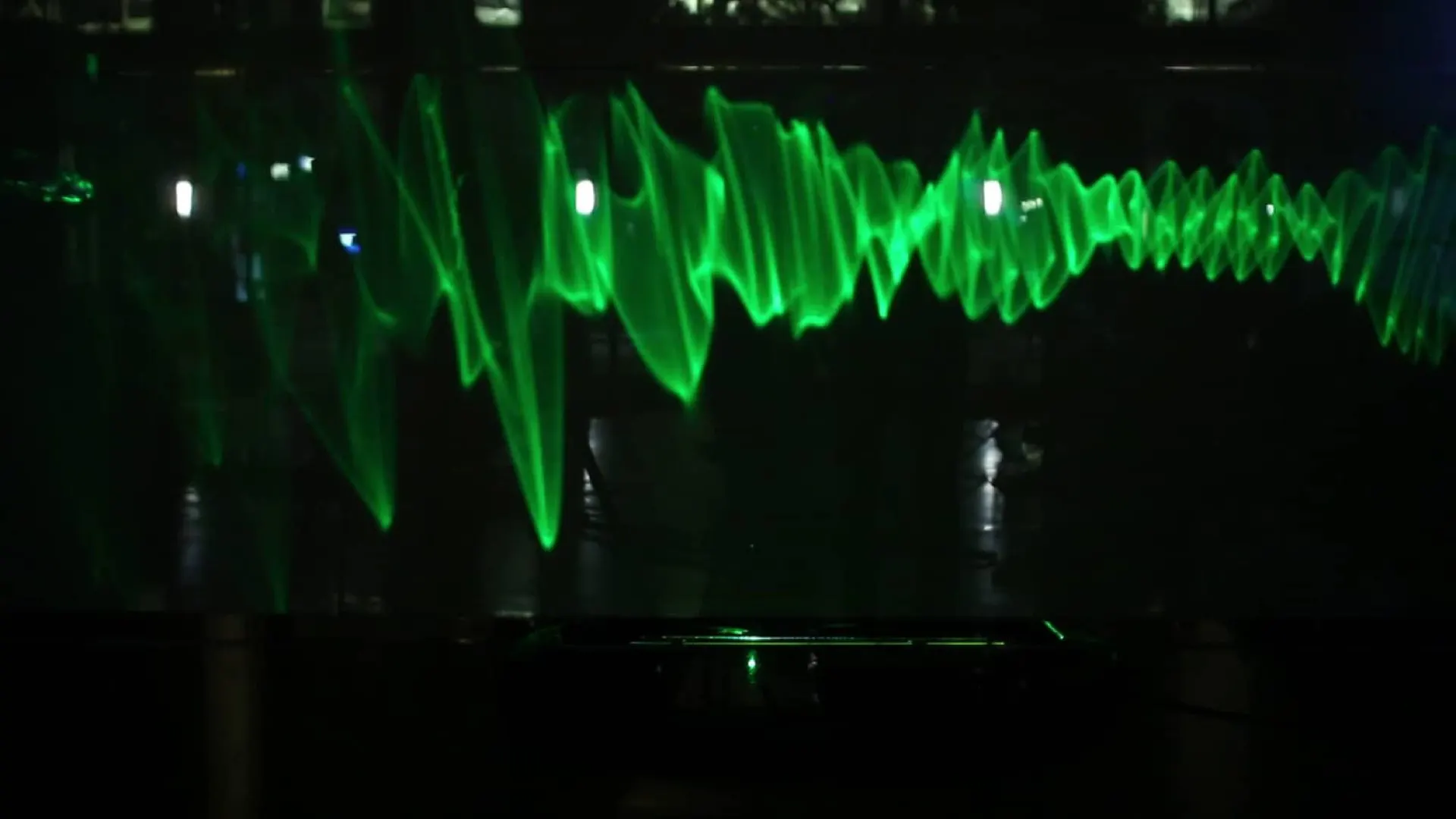
A cast bell hung over an anvil in the middle of the gallery. When you struck it, a microphone picked up the tone and fed it to a transducer mounted under a shallow pool of water. The pool's surface vibrated with the bell's overtones — standing waves you could see.
A green laser, aimed nearly flat across the pool, skimmed the surface and reflected onto a screen at the far wall. The screen drew whatever the bell was doing. Hit it once and you got a single bloom. Hit it harder and the drawing got messier.


Laser projection & signal chain: Samuel Stubblefield.
Innertube at the Bus Stop
Activated by the city.
Sidewalk sculpture, triggered by buses pulling up next door.

A knot of black truck innertubes sat on the sidewalk in front of the gallery, right next to a King County Metro bus stop. Most of the time it just sat there and people walked past it without registering it as art.
There were vibration sensors and small actuators inside. When a bus pulled up, the sensors picked up the rumble and the sculpture started to move — then went still again once the bus left. Riders coming off the bus usually caught it in motion and turned around to look.
Wired and wireless data systems, sensor-to-actuator electronics: Joshua Borsman. Concept and sensing collaboration: Samuel Stubblefield.
Tide-Driven Works
Live Puget Sound data, on the room.
Two pieces in this room ran on live tide data.


The wire-spiral turned in response to changes in the tide. The weather balloon, suspended midspan, inflated on the incoming tide and deflated on the outgoing one, working on a several-hour cycle.
Stand in front of either piece for a minute and it looked like a static object. Come back the next afternoon and it was in a different position.
The Heartbeat Room
A pendulum in a sealed dark chamber.
A piano string, struck on each swing, wired to a bass pickup.
Mark built this as a small chamber inside the gallery — pitch black, sealed from radio. A pendulum hung inside and swung back and forth, striking a piano string on each pass. The string was wired to a bass pickup, and the signal came back to the listener as a slow, low pulse that sat below speech and breath.
Standing in it felt like being inside a room that had its own heartbeat. It was my favorite piece in the residency.
No photographs were made of the chamber's interior; the piece depended on the room being absolutely dark.
By Mark Zirpel.
The Workbench
Soldering iron, batteries, parts bins, beer.
A lot of what mattered in the show happened at the bench in the middle of the room, not at the finished pieces.


The four of us building, debugging, swapping parts; visitors standing around the bench while we worked. Most of the conversations about the work happened there.
The Public Show
Opening night.

The gallery filled on opening night. The bell was striking once a minute, the wire-spiral was tracking the tide, the weather balloon was breathing in and out, and the sidewalk innertube was responding to every bus that pulled up. The workbench was still in the middle of the room, mid-build.
The Artists
-
Mark Zirpel
Sculptor · educator
Mark is, in the best sense, a mad genius. The Heartbeat Room — the sealed-dark pendulum chamber above — was his, and so was much of the residency's appetite for pieces that listen to something outside the gallery and answer it. The kind of artist who can carry a piece from sketch through electronics through finish without losing the first idea.
markzirpel.com → -
Amie McNeal
Artist
Amie can build almost anything, and you usually don't notice she's building it until it's done. I spent hours over her notebooks — concepts running from deep-sea creatures to welded sculptures that respond to the tides. Sharp, curious, quietly relentless.
-
Samuel Stubblefield
Artist · technologist
Sam works in computational and time-based media. He shaped the laser projection on the resonant pool, and was part of the concept and sensing work on the innertube piece.
-
Joshua Borsman Special Guest
Artist · maker
This was my first public show. I came in as a special guest and spent the residency absorbing concepts with the rest of the team — and built the wired and wireless data systems that connected the innertube sculpture's sensors to its actuators.
joshuaborsman.com →